
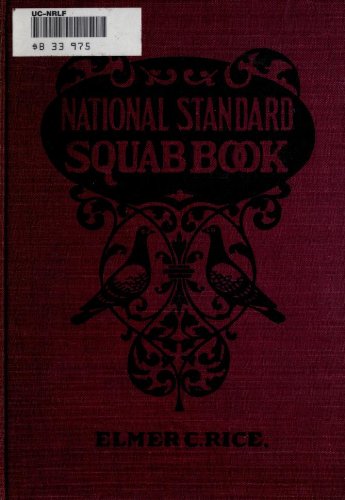
The National Standard Squab Book (Illustrated)
Product details
| Management number | 231971451 | Release Date | 2026/06/18 | List Price | US$0.69 | Model Number | 231971451 | ||
|---|---|---|---|---|---|---|---|---|---|
| Category | |||||||||
This volume was published in 1904.Excerpts from the book's Preface:This Manual or Handbook on squabs is written to teach people, beginners mostly, not merely how to raise squabs, but how to conduct a squab and pigeon business successfully. We have found breeders of squabs who knew how to raise them fairly well and took pleasure in doing so, but were weak on the business end of the industry. The fancier, who raises animals because he likes their looks or their actions, or because he hopes to beat some other fancier at an exhibition, is not the man for whom we have written this book. We have developed Homer pigeons and the Homer pigeon industry solely because they are staples, and the squabs they produce are staples, salable in any market at a remunerative price. The success of squabs as we exploit them depends on their earaing capacity. They are a matter of business. Our development of squabs is based on the fact that they are good eating, that people now are in the habit of asking for and eating them, that there is a large traffic in them which may be pushed to an enormous extent without weakening either the market or the price. If, as happens in this case, pigeons are a beautiul pet stock as well as money makers, so much the better, but we never would breed anything not useful, sala'ble merely as pets. It is just as easy to pet a practical animal as an impractical animal, and much more satisfying.This Manual is the latest and most comprehensive work we have done, giving the results of our experience as fully and accurately as we can present the subject. It is intended as an answer to the hundreds of letters we receive, and we have tried to cover every point which a beginner or an expert needs to know. It is a fault of writers of most guide books like this to leave out points which they think are too trivial, or "which everybody ought to know." It has been our experience in handling this subject and bringing it home to people that the little points are the ones on which they quickest go astray, and on which they wish the fullest information. After they have a fair start, they are able to think out their operations for themselves. Accordingly we have covered every point in this book in simple language and if the details in some places appear too commonplace, remember that we have erred on the side of plainness.It has surprised a great many people to learn that Homer pigeons are such a staple and workable article. They have been handled by the old methods for years without their great utility being made plain. When we first learned about squabs, we were struck by the impressive fact that: here was something which grew to market size in the incredible time of four weeks and then was marketed readily at a good profit. The spread of that knowledge will make money for you. Show your neighbors the birds you buy of us, and tell them the facts, and perhaps give them a squab to eat, then you will find a quick call for all the live breeders you can supply.From wikipedia:In culinary terminology, squab is the meat from a young domestic pigeon. The word squab was formerly used to describe young birds from several species, but has since come to mean young pigeons and their meat. Squabs are raised to the age of roughly a month before being killed for eating; they have reached adult size but have not yet flown. The practice of domesticating pigeon as livestock may have come from the Middle East; historically, squab or pigeons have been consumed in many civilizations, including Ancient Egypt, Rome and Medieval Europe. There is more information about recipes including squab eaten by rich people than those that poor people used. Although squab has been consumed throughout much of recorded history, squab is not usually a staple food in modern times, and may be considered peculiar or exotic. The modern squab industry uses utility pigeons and may use two-nest methods or selective breeding to improve yield. Read more
| ASIN | B003R0LJDW |
|---|---|
| XRay | Not Enabled |
| Language | English |
| File size | 2.1 MB |
| Page Flip | Enabled |
| Word Wise | Enabled |
| Print length | 174 pages |
| Accessibility | Learn more |
| Screen Reader | Supported |
| Publication date | June 9, 2010 |
| Enhanced typesetting | Enabled |
Bestseller ranking
Punches



Customers who viewed this product also viewed
Medals

![Medals Awarded to the Canadian Indians [microform]](https://m.media-amazon.com/images/I/61jgACzbAYL._SL1360_.jpg)



Correction of product information
If you notice any omissions or errors in the product information on this page, please use the correction request form below.
Correction Request Form